Kanazawa Tourist Information Guide
| HOME | INTRODUCTION | TOUR GUIDE | ACCOMMODATIONS | EVENTS | DOWNLOADS | PHOTO | LINKS |
Whats New
- English website of Michelin Guide Toyama/ Kanazawa 2016 unveiled
- Kanazawa a Cappella Town 2016~ Music all around downtown for two days
- Special Early Morning Visit to Shirayama Hime Shrine
- The 65th Hyakumangoku Festival
5 stars hotels in Tokyo


Tour Guides
・
Kanazawa Tourist Spots
・
Sample Itineraries for Gokayama, Shirakawa-go, Takayama
Newsletters
Newsletters which present Kanazawa's charm points.
Craft Tourism
UNESCO appointed Kanazawa as a City of Crafts and Folk Art in the Creative Cities Network.
We recommend that you try out the city's traditional arts and crafts.
Explore Kanazawa with a tour guide
4 stars hotels in Tokyo


| National Licensed Guide Licensed Interpreter-Guide Net Kanazawa |
Kenrokuen Garden
One of Japan's Three Most Beautiful Gardens
Kenrokuen Garden is a beautiful Japanese garden with an area of 11.4 hectares located on the heights of the central part of Kanazawa and next to Kanazawa Castle. The Maeda family, who ruled the Kaga Clan (the present Ishikawa and Toyama areas) in feudal times, maintained the garden from generation to generation. From its scale and beauty, it is regarded as one of the most beautiful feudal lords' gardens in Japan.
3 stars hotels in Tokyo


Kenrokuen Garden has a big artificial pond, and hills and houses are dotted in the garden. Visitors can appreciate the whole, dropping in at them. The big pond called "Kasumigaike" was compared to an open sea, and an island, on which an ageless hermit with miraculous power was believed to live, was constructed in the pond in hope of the long life and eternal prosperity of the lord. Kenrokuen, which means "having six factors", was given the name because of the six attributes that bring out the perfect landscape of the garden: spaciousness, tranquility, artifice, antiquity, water cources, and magnificent view from the garden.
There is a stone lantern designed in the image of the Japanese koto (harp) by the pond, which becomes the symbol of Kenrokuen Garden. There is a fountain created using the natural pressure of water flowing from the higher pond.
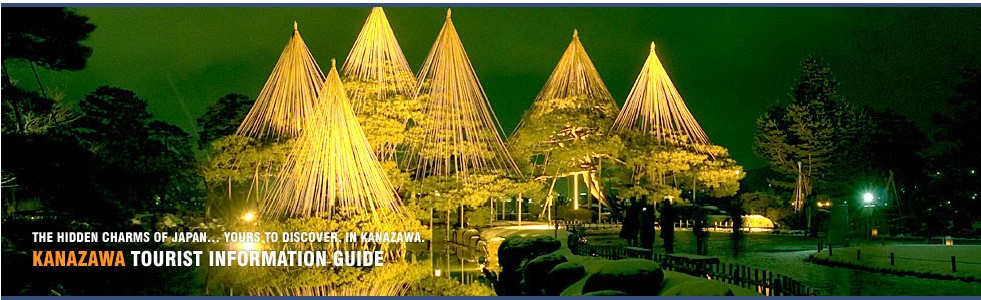
Visitors can enjoy the beauty of the flowers and trees, such as plum and cherry blossoms in spring, azaleas and irises early in summer, and colorful red and yellow leaves in autumn. Besides, visitors will have a glorious view of seasonal natural beauty including the snow-covered landscape with yukitsuri (literally means snow hanging), which is performed for approximately one month from November 1 every year. This is a method of protecting the branches of the pine trees in the garden with ropes attached in a conical array to the trees in order to prevent the branches from breaking.
Family hotels in Tokyo


Kanazawa Castle Park
Ruins of Castle Where Maeda Family of Kaga Clan ResidedIn 1583, Lord Maeda Toshiie, who was Toyotomi Hideyoshi's first retainer, moved to Kanazawa. The Maeda family resided in Kanazawa Castle and governed the Kaga Clan (the present Ishikawa and Toyama areas) for more than 280 years henceforth. The castle tower was burned down by a fire in the past and has not been rebuilt, but other fortress buildings were reconstructed repeatedly. The Ishikawamon Gate, which was rebuilt in 1788, and the Sanjikken Nagaya (50-yard-long warehouse), which was rebuilt in 1858, still remain. Both of them have been designated as Japan's important cultural assets.
The place was used as a base of the Japanese army. Later, Kanazawa University used it as a campus. The place was repaired in 1996, and the Hishiyagura (diamond-shaped turret), Gojikken Nagaya (90-yard-long warehouse), and Hashizumemon Tsuzuki Yagura (turret protecting the nearby gate) were restored and the park opened.
In the time of the Maeda family, moats surrounded Kanazawa Castle. The castle had a fort function with loopholes for matchlocks on the outer wall to defend the castle from enemies. The beautiful white tiles that grace the roof are weathered lead and the wall is made of white mortar with flat tiles attached to it.
Best budget hotels in Tokyo


The stone walls vary in type with each place, and it is apparent that the stonewalls were built in separate periods. The stone walls include those built more than 400 years ago.
Hishiyagura, Gojikken Nagaya, and Hashizumemon Tsuzuki Yagura
The Hishiyagura (diamond-shaped turret), Gojikken Nagaya (90-yard-long warehouse), and Hashizumemon Tsuzuki Yagura (turret protecting the nearby gate) are large-scale wooden castle buildings reproducing the original sights of approximately 125 years ago. The turrets on the right and left to watch the gate are connected with the Gojikken Nagaya. The traditional construction method and the roles of the castle in those days are introduced in the buildings.
Kahokumon-gate
The reconstruction of the Kahokumon-gate, which had disappeared 130 years ago, was completed in Japan's traditional construction methods based on historical facts. The Kahokumon-gate, which is virtually the main gate of Kanazawa Castle, is located down Kahokuzaka Hill past the Otemon-gate of Kanazawa Castle. The Kahokumon-gate, Ishiwakamon-gate, and Hashizume-mon gate are regarded as the three major gates of Kanazawa Castle.
The interior of the gate is open to the public for free.
Basic Information
Located in the central part of the mainland of Japan, Kanazawa is the prefectural capital of Ishikawa Prefecture. The southeast area of the city faces the mountains and the northwest area faces the Sea of Japan. The main city area is located between the Saigawa River and the Asanogawa River. Kanazawa Castle Park and Kenrokuen Garden (one of the three greatest gardens in Japan) are located in the center of the city, and they are surrounded by several shopping districts (Korinbo, Kata-machi, Musashi, and Kanazawa Station).
Popular Hotels in Tokyo


Kanazawa has a population of 464,431 (as of October 2014), and it is the center of the economy and culture of the Hokuriku area (consisting of Toyama Prefecture, Ishikawa Prefecture, and Fukui Prefecture). The shopping districts in the city are crowded with shoppers from various parts of Hokuriku on holidays.
Moreover, Kanazawa is a leading tourist city where 8 million tourists visit every year. It was a great castle town ruled by an influential leader from the 17th century to the second half of the 19th century. Kanazawa has not suffered from any war devastation or big natural disasters. Thus, Kanazawa has maintained rows of historical houses and various traditional handicrafts and traditional performing arts.
The Hokuriku Shinkansen (a high-speed railway line) from Tokyo to Kanazawa started operating on March 14, 2015, and the further economic development of Kanazawa is expected, along with an increase in the number of sightseers.
The climate of Kanazawa is almost as mild as that of Tokyo or Osaka. There are few days with temperatures below freezing between December and February. However, there are few days of fine weather, and the snow often piles up.